


Editor’s note: a character from my favorite sitcom, 30 Rock, is whispering “synergy” in my ear, so I’ll say this just once: if you happen to be a fan of the comedy sketch show “Saturday Night Live,” or are close with someone who is, I’ve started a Substack where I review episodes of the US version (and hopefully soon the UK version if I can find the time).
It’s very tempting to say, “well, there was good and bad,” and present a neutral take after these first four games under Xavi.
But you know what? Screw that. Because I don’t actually think there’s much reason for any doom and gloom. If you had told me, “Xavi will be top of the Nations League group with no defeats through his first four games,” I absolutely would’ve taken that. Of course, the Dutch got lucky that Greece were also able to stifle Germany to a tie. But this was a largely successful international break.
Of the four games played under Xavi, I think you can easily argue that his team deserved to win all four of them. Take a look at the momentum charts for each game, which show how likely the team in possession of the ball is to score in the next ten seconds, courtesy of the fjord-dwelling1 Norwegians who run the incredible website FotMob:
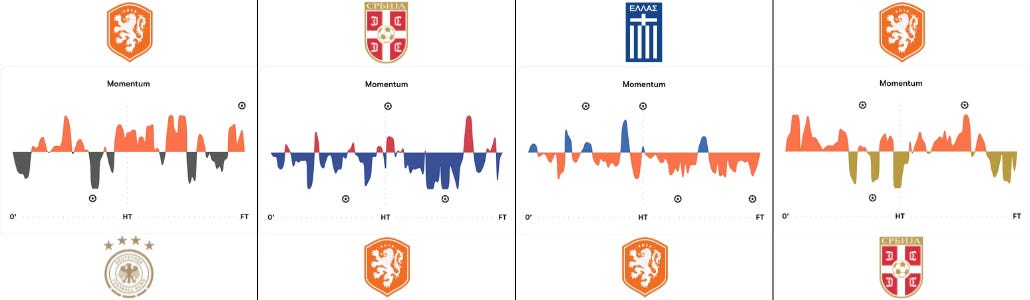
Goals are aided significantly by luck. But as you can see, in each game, the team that consistently put more pressure on their opponent was the Netherlands. And that’s incredibly promising, especially when you consider the circumstances around these games:
This was Xavi’s first time meeting the players, seeing them in practice, and getting a true understanding of their talents, preferences, and abilities.
This was Xavi’s first time on the job as an international team coach, versus being a club team coach.2
Many of the best Dutch players were either out injured or got injured during this break: Frenkie de Jong, Xavi Simons, Donyell Malen, Jerdy Schouten, Matthijs de Ligt, Ian Maatsen, Mats Wieffer, Justin Kluivert, Lutsharel Geertruida, Brian Brobbey, Cody Gakpo, Jan Paul van Hecke… I mean, are you kidding me? Wieffer and maybe Maatsen aside, these are all players who are in starting lineup contention.
Speaking of the players—what a huge adjustment it must be to have a new boss in a job where you haven’t had many new bosses. Let alone one for whom all communication has to be in English, which hasn’t happened since before the Super Bowl was a thing.3
Would the results have been better without these circumstances? Of course. De Jong and Simons alone are game-changing talents. But I think it’s understandable that Xavi would see these conditions and think: let’s try some stuff. Let’s try a midfield of Joey Veerman, Quinten Timber, and Guus Til. Let’s try lining up Teun Koopmeiners (a midfielder) as a central defender. Let’s try some different formations and systems to see what works and what doesn’t.
This experimentation with the chess pieces is one reason why I think we shouldn’t judge Xavi based on the four games total—it’s actually impressive how he has been able to identify shortcomings and repair the squad during the course of the games, the mark of a good coach—but instead I think we should judge him on the best half of soccer he’s been able to produce. And that’s the second half of his first game versus Germany. During which, by the way, the Dutch looked absolutely electric.
There’s another reason why I think we shouldn’t judge Xavi too harshly based on his team scraping by against Serbia twice and going down 2-0 to Greece before halftime: we just have no idea what is going on in his head. In postgame interviews, the Spaniard has been somewhat repetitive with a small box of superlatives (“personality,” “this is the way,” “this is not the way”), maybe due to his lack of total English fluency, or maybe he wants to keep things that way. I remember during Ronald Koeman’s tenure, there were games where the team looked like they had been given specific instructions, and games where it looked like Koeman just said, “let the boys play.”
If there’s one clear difference between Xavi and Koeman, it’s their north star. Koeman, like Louis van Gaal before him, prioritized control of the game over all else. Control the game, minimize risk, and avoid defeat. It’s why I think the extra-time periods against Argentina in 2022 and Morocco in 2026 looked very similar; it was more important to be organized defensively, and avoid conceding a goal, than it was to take the risk to move players forward and try to score. Flawed as that may be in hindsight, considering the Dutch misfortune surrounding penalty kicks, both coaches figured that control was easier to exert over penalties than over a 30-minute period where most of your players are dog-tired. It’s agonizing how close this plan was to succeeding—if only Virgil van Dijk had shot his penalty in 2022 with more conviction, like he did here; if only Justin Kluivert this summer hadn’t mirrored (ignore that it says “Timber”) his father’s penalty miss in 2000.4
Xavi, on the other hand, is fully focused on one thing: attacking and scoring goals. It has been so refreshing to see over these four games. No longer are Dutch defenders passing the ball back and forth, putting viewers to sleep in the name of controlling the pace of the game; it’s now visible that every player’s intention when they receive the ball is to figure out a way to move it forward, with the ultimate aim of scoring a goal.
The founder of modern Dutch soccer, Johan Cruijff, once said, “I’d rather win 5-4 than 1-0.” For the better part of two decades, Bert van Marwijk, Louis van Gaal, and Ronald Koeman have forced the country of “18 million national team coaches” (a popular saying that conveys how everyone in the Netherlands has an opinion on the national team) to watch a team that wants to win 1-0. Finally, under the first foreign coach since the Austrian Ernst Happel in 1978, we’re once again being treated to a team that wants to win 5-4.
That sounds like a great way to end this post, but I haven’t really talked about the game against Serbia itself! Although, given all the reasons I listed out earlier, I don’t think it would do much to try to analyze this game too closely. There was nothing better than the loud roar of the crowd at the referee’s final whistle; the 35,000+ fans had just seen their team be forced to defend with grit and passion for the last few minutes, because defender Micky van de Ven had to leave the field due to injury and the Dutch were out of substitutions. Not the most fun watch, but the relief felt when the game ended would put a smile on anyone’s face.
One standout I have to mention, though, is Gjivai Zechiël, who stole the show after coming on for the last half-hour. He injected a necessary energy into the squad, and he was involved in creating the winning goal (see the goals at the bottom). Overall, the Eredivisie comes out of this break looking pretty good. Feyenoord’s Zechiël, PSV’s Ruben van Bommel, and AZ’s Mexx Meerdink, the trio of debutants, all had shining moments that showed that the future is bright, and that there is real talent in the Dutch league. Good thing you’re able to follow it here, my beautiful subscribers.
Lastly, this was a milestone game for Virgil van Dijk: it was the Dutch captain’s 100th game, or “cap,”5 representing his country. He joins a short list of Netherlands legends who have accomplished the same feat: Wesley Sneijder, Edwin van der Sar, Frank de Boer, Memphis Depay, Rafael van der Vaart, Daley Blind, Giovanni van Bronckhorst, Dirk Kuijt, Robin van Persie, and Phillip Cocu. If you’re wondering why the list is recent-times-heavy: it’s because there are simply more international games on the calendar now than there were 40+ years ago. Otherwise you’d see players like Ruud Krol, Ronald Koeman, and maybe Marco van Basten among the names. Virgil—he wears “Virgil” on his jersey instead of “Van Dijk” to honor his mother rather than his father, who abandoned the family when the Liverpool defender was young—is one of the greatest players to have ever worn the Oranje shirt, and should have won the most prestigious prize in soccer, the Ballon d’Or, in 2019.
The next international break will begin November 9, with two critical final group stage games: hosting Greece and visiting Germany. Those will be huge for Xavi, as good results will mean advancing to the quarterfinals (played over two games) and being just a few wins away from the first trophy since 1988.
But don’t worry, there will be Oranje discussion before November—in my weekly Eredivisie previews and recaps, there’s an “Oranje Corner” section.
Highlights of the game below.
Just the goals:
I’m not being racist or whatever you’d call it: they’re literally rooted in the fjords.
“That sounds very similar, though.” Yes, but also no. Coaching a club is a slow marathon, while this is a series of sprints. You don’t get to see your players on the practice field every week; you don’t have the luxury of carefully putting together a squad. You need to know how to make the most out of just a few days of practice, and how to best communicate complex ideas to players quickly. It’s all so much more condensed, and I imagine the pace and pressure are much higher. Imagine if, instead of making slide decks over the course of a year, you only got to watch slide decks be made until the four three-week periods every year where you had to make slide decks. Not sure if that analogy works, but footnotes are a lawless land!
Ernst Happel, the previous foreign coach in 1978, didn’t speak English; he spoke German and very limited Dutch. He was known as a man of few words; his pregame speech before the 1978 final was simply, “Gentlemen, two points.” Because back then, winning a game gave you two points, not three. The previous English-speaking national team coach was Denis Neville in 1966.
This was especially heartbreaking for the young Kluivert, who is usually a master penalty taker at his club, the English Bournemouth. He hasn’t yet made his mark in the national team, but I hope that if he’s not injured in November, he can show us how talented he really is.
An appearance for your national team is called a “cap” because it used to be tradition that players would receive embroidered, commemorative hats for each game they played for their country—a tradition people in the UK borrowed from cricket.